AI for UK Healthtech_

AI you can show your investors.

Production AI for UK healthtech founders — built so DTAC v2, investor diligence, and your clinical-safety officer all sign off on the same artefact.

Book a 30-min readiness call
WHAT KEEPS FOUNDERS UP AT NIGHT_

You're shipping AI in the most sensitive data category UK law recognises. Three things keep you up.

The diligence room

Your next round's lead investor will ask how the model handles patient data, where it lives, who can see prompts, and what happens when it hallucinates. Their technical due-diligence partner will ask harder questions, in writing, and want the evidence file.

The clinical-safety question

Reviewers — MHRA, your CSO, the procuring NHS trust — will want evidence the AI is safe by design, not safe by hope. DTAC v2 went live on 6 April. Pre-v2 evidence packs no longer pass.

The procurement maze

NHS trusts run an evidence checklist that wasn't written with AI startups in mind. Founders who navigate it ship. Founders who improvise stall — at the procurement stage, after the trust is sold on the product.

WHAT WE BUILD_

Production AI, built for the people who'll review it.

Teque builds production AI for UK healthtech — RAG over clinical and patient text, agentic workflows, classification, summarisation, decision support. Shipped behind audit logs, with governance baked in upstream, not retrofitted under a deadline.

What "governance baked in" means in practice:

  • Article 9-grade data handling — encryption (including field-level where the threat model demands it), tenant isolation, access control, prompt and response logging under your control, retention you set, sub-processor governance decided before code ships.
  • DTAC v2 evidence pack — your dossier aligned to the standard your reviewers actually use, so your next trust DDQ, audit, or investor diligence call has answers ready, not improvised.
  • Clinical-safety scaffolding — DCB0129 / DCB0160-shaped artefacts, hazard log, model behavioural envelope, fail-safe defaults documented alongside the code.
  • Reviewer-ready architecture — system design documented arc42-style so a fractional CTO, CSO, or investor-side reviewer can read and verify it in 30 minutes.

Why "baked in" beats retrofitted → how we build AI with governance from day one
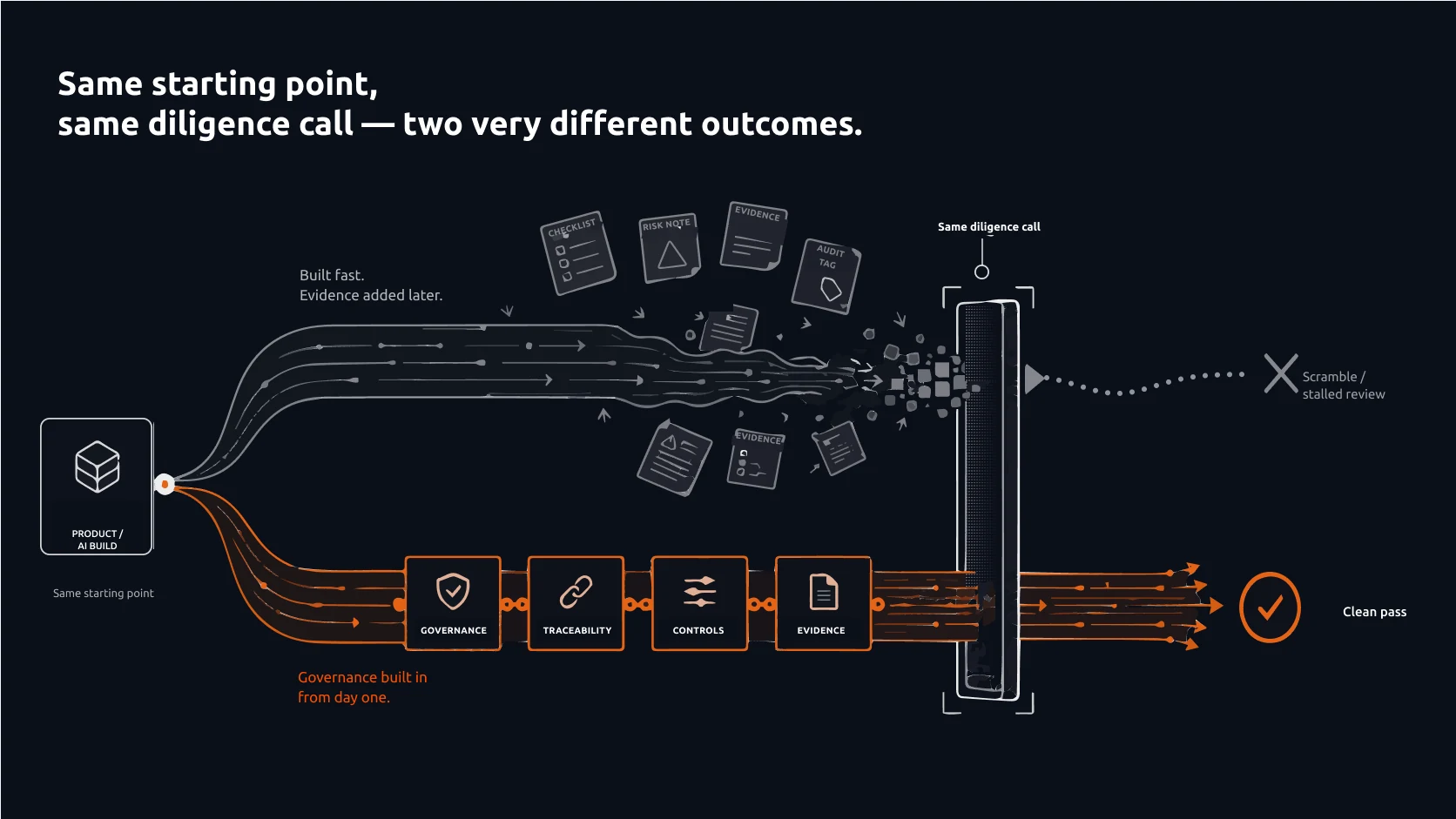
Same starting point, same diligence call — two very different outcomes. With governance bolted on afterwards, the review becomes a scramble of evidence and stalls; with governance baked in from day one — governance, traceability, controls, evidence — the review is a clean pass.
RECENT WORK_

Shipped work, not a pitch.

Teque ships production AI for UK healthtech — RAG, agentic workflows, classification, summarisation — built against Article 9 data, with governance dossiers shipped as deliverables, not retrofitted under a deadline.

Production AI for a UK pre-seed healthtech startup

Article 9-class data; retrieval over their proprietary clinical dataset; governance dossier shipped as part of delivery — so their next investor and reviewer conversation has artefacts, not promises.

Charity Health Check

A production agentic AI tool we built and shipped for the UK charity sector. Live, clickable, recursive proof of the same architecture discipline that ships here.

Try the Charity Health Check

How we deliver

Teque engagements are designed and delivered by a small core team led by founder Saleem Beg, plus named specialist contributors brought in per brief — clinical-safety officer support, security audit, frontend, infrastructure. The contract names every contributor; their work shows up in the arc42 documentation your fractional CTO can verify. No anonymous offshore pool; no surprise sub-contracting.

Saleem's 12 years of regulated-data architecture work — Article 9-class beneficiary records at Embrace and HHUGS, NGO financial PII at scale, the Go-binary PII obfuscation library still running in production — underpins every Teque build.

Saleem on LinkedIn

Standards we work to

  • ISO 27001-aligned data handling
  • arc42 architecture documentation
  • DCB0129 / DCB0160 clinical-safety artefacts
  • DTAC v2-ready evidence
  • UK GDPR Article 9

We can produce the documentation your reviewers ask for — because we work to those standards before the diligence call, not in scramble mode after it.

HOW AN ENGAGEMENT RUNS_
01

30 min · free

We map your AI surface against DTAC v2, your data class, and your investor / clinical-safety risk surface.

Deliverable: a written summary of what's in scope, what's missing, and what we'd build first. No deck, no follow-up sequence.

02

1–2 weeks · fixed fee

We produce the architecture, governance dossier, evidence plan, and a shipped slice — a runnable proof of the AI behaviour against your real data class.

Deliverable: all four artefacts — you own them whether or not we build the rest.

03

4–12 weeks · fixed scope

RAG, agentic workflows, audit logs, retention controls, clinical-safety scaffolding.

Deliverable: production AI delivered with the documentation your next reviewer will ask for.

04

your call

Hand to your CTO or fractional CTO with full arc42 docs — or we keep operating it with you on a defined run rate.

Deliverable: a clean handover or a defined run rate — documented either way.

FAQ_

Questions founders and fractional CTOs ask first

Yes. We've aligned to the v2 standard since the 6 April cut-over and can produce the evidence pack your trust procurement or investor reviewer will ask for.

It stays in your environment. Tenant isolation, prompt and response logging under your control, retention you set, sub-processors documented and approved before use. No training data flows back to us or to a model vendor.

Teque is a boutique — a small core team led by founder Saleem Beg, with named specialist contributors (clinical-safety, security audit, frontend, infrastructure) brought in per brief. Every contributor is named in the engagement contract; no anonymous offshore pool.

Yes; most engagements do. We document everything arc42-style so your fractional CTO can verify the system's behaviour without taking our word for it.

Three layers — retrieval grounded in named sources, response logging with provenance, fail-safe defaults for clinically-relevant outputs. We document the model behaviour envelope so your CSO and reviewers can read it.

More on the engagement model: how a Teque project runs →

Book a 30-minute readiness call

Bring your data class, your current reviewer pressure, and what you've shipped so far. Leave with a written summary of what's missing and what to build first. No deck. No pitch. No follow-up email sequence — we treat your inbox the way we'd want ours treated.

Book a readiness call