Data, Security & Compliance_ · 9 min read
How Hysteron launched a women’s health platform it can stand behind
19.11.26
Hysteron, a UK women’s health start-up, launched its at-home blood test service in October 2026 with its customers’ health data handled properly: rules it can explain to anyone who asks, and a platform that checks them every time it changes. Teque, a London software and AI agency, designed those rules with Hysteron’s founder and CEO, Verity Fotheringham, and built the checks into the platform.
The situation
Hysteron helps women in perimenopause and menopause understand what is happening to their bodies. Customers order a blood test at home, answer questions about their symptoms, and get results that bring the two together. So health data sits at the centre of the business, and UK data protection law protects health data more strictly than almost anything else.
Its founder and CEO, Verity Fotheringham, is not technical. Saleem Beg became Hysteron’s technical lead in April 2026, with launch set for October, Menopause Awareness Month.
What a health start-up founder worries about
When you build a business on health data, the same questions keep coming up:
- When an investor, a partner or a legal reviewer asks how you protect your customers’ data, do you have a good answer?
- Could a change to your platform quietly break a promise you have made to customers?
- Is your website giving away more about your visitors than you realise?
- Can you trust the results your customers see?
- And can you do all of that and still launch on time, on a start-up budget?
Here is how Hysteron answered each one.
“How do you protect your customers’ data?”
Hysteron can answer that in writing, in its own name. Before any new code was written, we wrote its data governance: the rules for how customer data is collected, stored, used and deleted. A security standard, a design for where each kind of data lives, and a register of the risks and what is being done about each one followed. It is all built around ISO 27001, the international standard for information security, so Hysteron is on the path to certification, which it is aiming for in its second year.
Just as important, the answer belongs to Hysteron’s founder. Every choice about customer data came to Verity as a few options in plain English, with a recommendation and what each would mean for her customers. By November 2026 there were 23 of those decisions on record, and every one was hers. Where something could not be done yet, the decision says so, along with what stands in for it until then. So when someone asks why Hysteron does something a certain way, the reasoning is written down and she can explain it herself.
“Could a change quietly break a promise to customers?”
A policy that only lives in a document drifts away from the product, because a platform changes every week. So we made Hysteron’s platform check its own rules. Take one of them: “the marketing website must not set tracking cookies”. There is an automated check for it, and every time the platform changes, the check runs. If a change would break the rule, it is stopped before it reaches the live site.
That is what lets a founder stop worrying about it, because the rules are kept by the platform rather than by someone remembering them. Twenty-three of Hysteron’s rules are checked this way so far, and once a rule has a check it keeps it. Between April and early November 2026, more than 900 changes to the platform went through these checks before going live.
“Is your website giving away more than you realise?”
Many founders don’t know about this one. On a website about menopause blood tests, a visit on its own can say something about someone’s health. The UK’s data protection regulator, the ICO, says that working out someone’s medical condition from the websites they visit can count as health data. Standard analytics and advertising tools, such as tracking pixels, send those visits to the companies behind them, and the ICO expects consent before they are used.
Hysteron’s website avoids the problem instead of managing it. It runs on Storyblok, a content system that is itself ISO 27001 certified, chosen so Hysteron’s team can publish everything themselves, with separate roles for who can edit and who can publish. It sets no tracking cookies, so there is no cookie banner to click through, and Hysteron still sees how its marketing is doing, in a privacy-friendly way that keeps tracking pixels out of visitors’ browsers. And because “no tracking cookies” is one of the checked rules, a later change can’t quietly add them back.
“Can you trust the results your customers see?”
Each customer’s results come from logic built straight from Hysteron’s own spreadsheets. If anything in them doesn’t line up, for example a symptom answer that points to a question that no longer exists, the change is stopped before it goes live, and any change to the wording customers read in their results needs the founder’s sign-off. The first time the checker ran, before launch, it found 25 mismatches across the spreadsheets, “a few things I would never have caught”, as Verity put it.
“Can you still launch on time?”
Start-ups learn as they go, and Hysteron’s plan moved more than once, including a change of product in August that brought around a dozen new must-haves for launch. Each time, we agreed what had to be there on day one and what could follow, on a shared plan Hysteron could see at any time. Hysteron launched in October 2026, in Menopause Awareness Month, as planned.
How each kind of customer data is handled
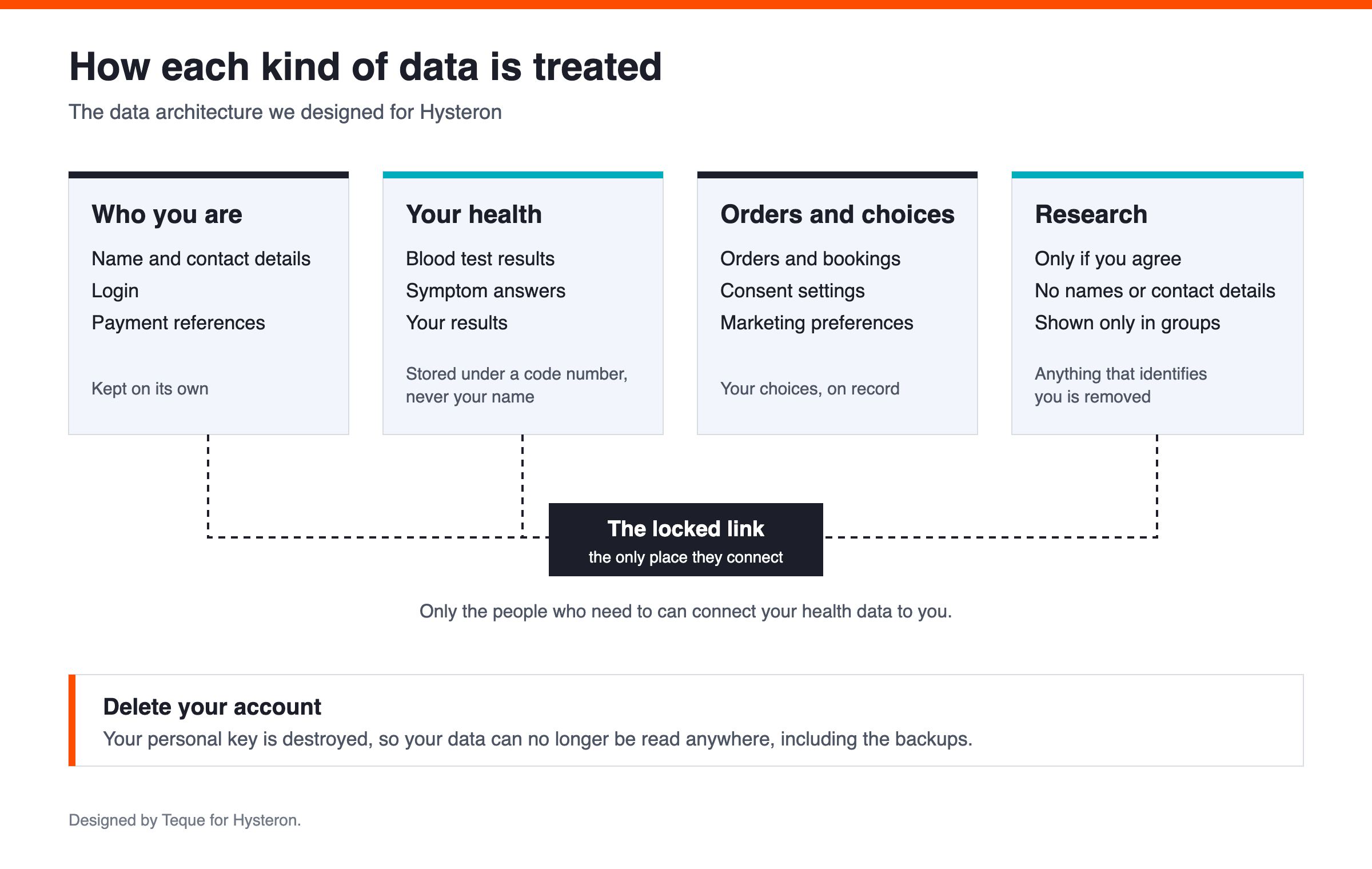
- Who you are: name, contact details, login and payment references, designed to be kept on their own.
- Your health: blood results and symptom answers, designed to be stored under a code number, never your name.
- Your orders and choices: orders, bookings and your consent settings, so your choices are on record.
- Research: used only if you agree, with your name and anything else that identifies you removed.
- The link between them is designed to sit in one locked place, so only the people who need to can connect your health data to you.
- Delete your account and the design destroys your personal key, so your data can no longer be read, including in the backups.
The honest part: what this taught us
- A phased plan beats a promise of everything. Start-ups cannot afford every protection at the start. What they can afford is knowing exactly what is in place, what is not yet, and why. A founder who can explain that is far harder to catch out than one who has been told “it’s all secure”.
- Rules only protect you if the platform checks them. A policy in a folder is where it starts. The peace of mind comes from a platform that stops any change that breaks it.
- Checks beat being careful. People miss things, especially in large spreadsheets late at night. Building the checks into the process did more for quality than any amount of care.
- Plan for the plan to move. Early-stage plans change because the business is learning. Keeping the launch date meant agreeing, every time, what had to be there on day one.
The results
- Hysteron went live on schedule in October 2026, despite a plan that kept moving.
- Hysteron has an answer, in its own name, for anyone who asks how it protects its customers’ data. At a legal workshop on data protection, Verity found she knew the rules on health data better than most of the room: “it looks like we know what we’re doing”.
- The platform keeps its own rules: every change since April, more than 900 by early November 2026, was checked against them before going live.
- Hysteron runs the day-to-day itself: its team publishes its own articles, manages its marketing and keeps an eye on cloud costs.
- Its founder is proud of the platform and happily sends people to it.
The takeaway
If your business runs on health data, someone will ask how you protect it, and the founders who sleep well are the ones who can answer with confidence. Write the rules first, in plain English, with every decision yours. Design for where you are going, and build towards it in an order you can explain. Then make your platform check the rules every time it changes, so keeping your promises to customers never depends on someone remembering them.
Testimonial

“He’s the most impressive and knowledgeable person I’ve ever worked with.”
“Working with Saleem has been fantastic. As a non-technical founder handling some of the most sensitive health data there is, I needed a technical lead I could trust and understand, and I knew almost straight away this was different. He designed our data governance from the ground up, built around ISO 27001 so we are on the path to certification, with a clear plan for what to do now and what to add as we grow. He’s a fantastic teacher, so I understood every trade-off and the decisions stayed mine. He challenges me, he’s on it the moment anything goes wrong, and it genuinely feels like he cares about Hysteron and is invested in it. We launched ahead of plan, and I’m proud of what we’ve built. He’s the most impressive and knowledgeable person I’ve ever worked with.”
Her advice to other founders: “Find someone who will ask questions and tell you when you’re on the wrong track. That’s why you hire an expert.”
Read the Hysteron case study.
Published 19 November 2026 · Last reviewed 19 November 2026
Keep reading_

10.08.26 · 7 min read
Answerable by Design: The AI Decision Engine Behind CANDID8.AI, Built by Teque
CANDID8.AI helps decide who gets a shot at a job. Here is how Teque built its decision engine to be answerable by design: every call it makes can be seen, explained, and stopped.
Read more →

04.07.25 · 5 min read
“Help! I Think I’ve Been Hacked” — What to Do (and What Not to Do)
It’s happening a lot right now. More than ever before, we’re hearing from people — charity workers, business owners, even...
Read more →

11.03.26 · 5 min read
Why Skipping Discovery Is the Most Expensive Decision in Software
When someone internally champions a software project, the instinct of the person signing the budget is usually the same: skip...
Read more →