What’s draining your time, profit, and team — and what to do about it
Ever feel like you’re running a modern accounting firm… on medieval workflows?
You’ve got cloud software. Maybe even a few flashy tools. But your team is still rekeying data, hunting down files, chasing clarity across systems. Everything’s digital — and yet, nothing quite works together.
Sound familiar?
You’re not alone. Many small-to-medium accounting firms across the UK are dealing with the exact same issue. But here’s the twist: it’s not the tools that are broken — it’s the gaps between them.
In this post, we’ll unpack the hidden cost of poor integration, why it’s so common, and how a small mindset shift can transform the way your firm works (without adding more software to the pile).
Modern Tools, Medieval Workflows

There’s a dangerous illusion in accounting today: that cloud = efficient.
Just because you’ve swapped desktop software for Xero, Dext, Karbon, or FreeAgent doesn’t mean your systems are integrated. In fact, most firms we speak to are still living in copy-paste hell — manually stitching together reports from Excel, client data from email threads, and payment info from half a dozen tabs.
And it’s costing them more than they realise.
The Real Price of Disconnected Systems
Let’s break down the hidden cost of poor integration. Not in abstract IT terms — in real-world accounting pain.
The Cost of Repetition
Your team enters the same data multiple times — once into the CRM, again into the ledger, and again for reporting.
That’s not “just how it is” — that’s wasted time. Repetition is an invisible payroll expense.
Think of it as an admin tax you’re paying every week. And no, it’s not deductible.
The Cost of Mistakes

Different tools = different versions of the truth.
One says a client’s balance is settled, another says it isn’t. Now someone’s double-checking, triple-checking, and explaining it all to the client — who’s understandably annoyed.
What looks like “human error” is often just system error, caused by poor integration.
The Cost of Delay
Reports are slow. Client insights are scattered. Strategic decisions are made based on data that’s days or weeks old.
That might not feel urgent — until you miss something critical. Like a cash flow gap. Or a client about to churn.
In a real-time world, delay is dangerous.
The Cost of Frustration
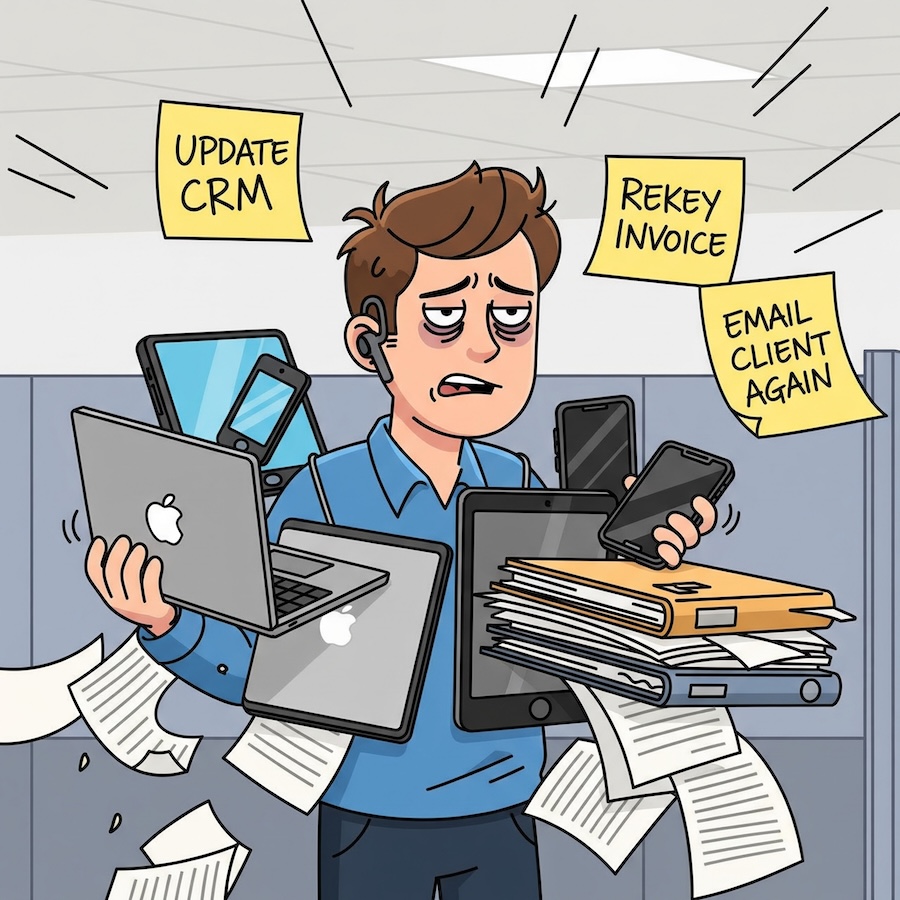
People didn’t become accountants to spend hours cleaning data and chasing documents.
Yet here they are, being the glue between tools. Morale drops. Talent leaves. Hiring becomes harder.
And let’s be honest — nobody updates their LinkedIn saying, “Skilled in dragging CSVs into spreadsheets.”
The Cost of Growth Bottlenecks
The more clients you take on, the more disjointed your systems become. What worked at 50 clients breaks at 150.
Suddenly, scaling feels like sprinting through treacle.
Why It Happens (And Why It Keeps Happening)
Here’s the kicker: most firms know their systems are clunky. But fixing it feels overwhelming.
Why?
- Because firms don’t think like digital businesses.
They still treat tech like admin support, not infrastructure. - Because IT support is reactive, not strategic.
If it runs, it’s fine — until it’s not. - Because hiring a developer feels expensive and risky.
And even if you do, who’s managing them? What are they building? - Because vendors sell “integrations” that only sync the basics.
Sure, it pushes invoices from A to B. But it doesn’t join up your actual processes. - Because DIY automation tools break down fast.
Zapier and Make are brilliant — until you need error handling, logic, or scale.
All of which leaves firms stuck in limbo. Knowing something’s wrong… but unsure how to move forward.
A New Mindset: Integration as Infrastructure
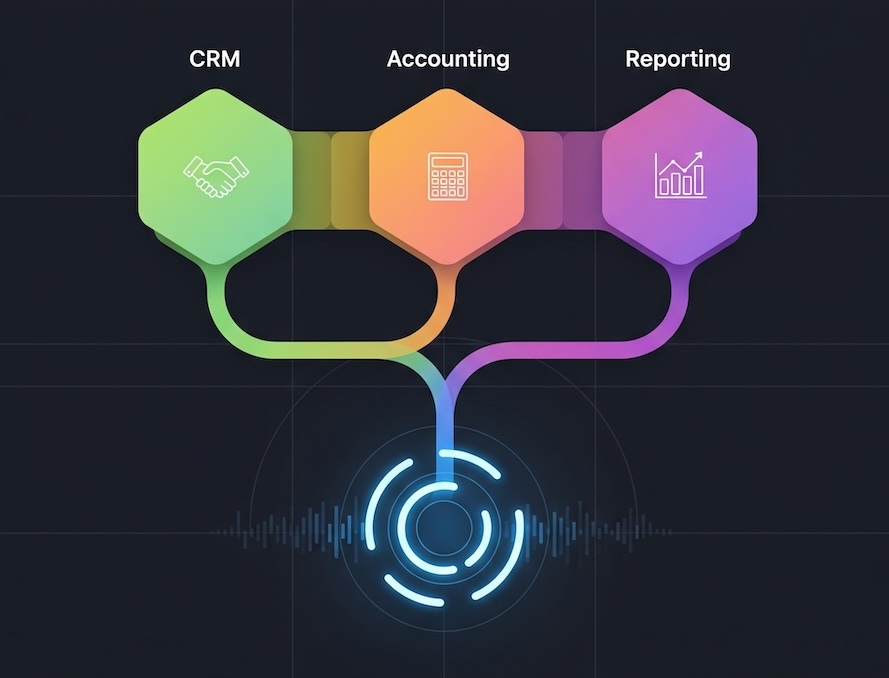
This isn’t just about tech — it’s about thinking like a system designer.
That doesn’t mean hiring a full dev team or turning your partner into a product manager. It means stepping back and asking:
- Where is our time leaking?
- Where are we duplicating effort?
- Where are humans being used as glue?
- Where is a “report” actually just a series of manual exports?
From there, you can start to map your data flows and make small, high-impact changes.
Even something as simple as syncing your CRM with your billing system can save hours, reduce errors, and give you a clearer view of your clients.
What Forward-Thinking Firms Are Doing
The firms that are pulling ahead? They’re doing a few things differently:
- They’re treating integration like infrastructure, not an afterthought.
- They’re investing in clarity, not more clutter — connecting what they already use.
- They’re unlocking hidden capacity by reducing the admin burden.
- They’re making life easier for their teams — which makes it easier to retain talent.
And they’re not doing it all at once. They’re taking small, smart steps — guided by a clear strategy, not shiny software.
Want to Talk It Through?
If this post has struck a chord and you’d like to talk through your firm’s integration challenges — no pitches, no jargon — we’re always up for a chat.
Sometimes a fresh perspective is all it takes.